Are Companies Replacing Industrial DTG Printers with DTF?
Direct-to-film (DTF) printing has grown rapidly in the apparel decoration market. As adoption increases, so have claims that print businesses are replacing industrial direct-to-garment (DTG) systems with DTF printers.
But is DTF actually replacing industrial DTG?
The short answer is no, not across the board.
DTF and industrial DTG address different production requirements. In fact, newer technology is making the choice less binary. Kornit Atlas MATRIX, for example, combines direct printing on cotton, polyester, and blends with advanced Direct-to-Film capabilities.
The more useful question for high-volume producers is:
Which production method delivers the required finished garments at the right quality, speed, and total cost?
Key Takeaways
- Growth in DTF doesn’t mean industrial DTG is being replaced.
- DTF and industrial DTG address different applications and can coexist in the same production environment.
- Transfer output and finished-garment output are not the same measurement.
- The right comparison should consider total workflow, labor, cost, quality, and finished-garment output.
DTF Is Growing
There are good reasons for DTF’s growth.
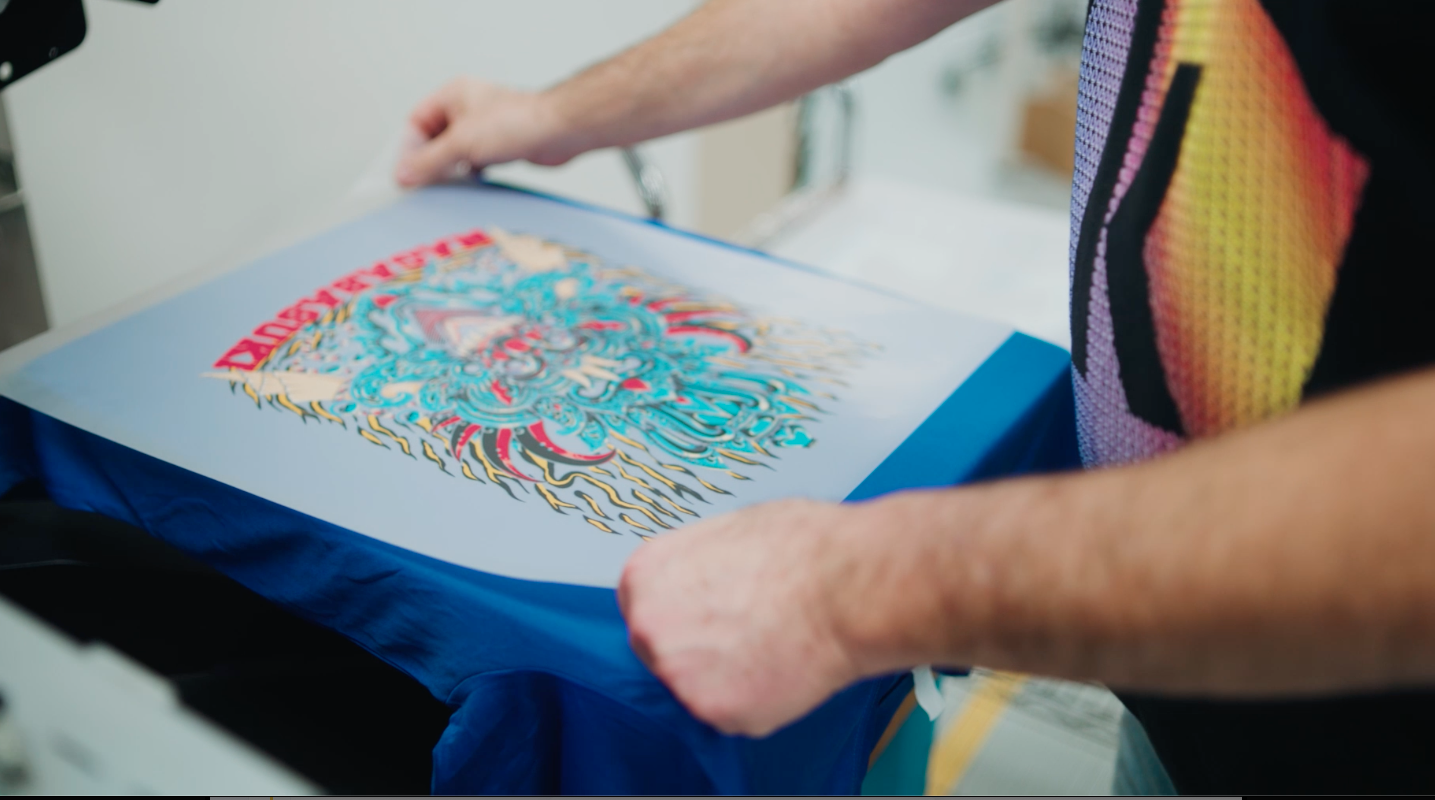
DTF allows designs to be printed onto transfer film and later applied to garments using heat. Transfers can be produced independently of the final garment, stored until needed, and used across different products.
But growth in one technology doesn’t necessarily mean another is becoming obsolete.
For a broader explanation of how the technologies differ, see our guide to DTG vs. DTF printing.
For industrial producers, the important difference is the complete production workflow.
A simplified DTF process can include:
Print transfer → apply adhesive → cure → prepare transfer → position on garment → heat press → finish
Industrial DTG prints directly onto the garment.
Kornit systems also integrate pretreatment into the printing process. Kornit Apollo takes automation further with automatic loading and unloading, pallet adjustment, printing, and integrated curing.
This creates an important distinction:
Transfer production speed is not the same as finished-garment production speed.
Is DTF Faster Than Industrial DTG?
It can be.
DTF systems can continuously produce transfers, with multiple designs arranged across a roll. But those transfers still need to be applied to garments.
Industrial DTG measures production differently.
Kornit Apollo is designed for mass-production DTG and can produce up to 400 impressions per hour with a single operator.
Kornit Atlas MAX PLUS can produce up to 150 impressions per hour with a single operator.
Rather than comparing how many transfers or prints a machine produces, businesses should ask:
How many finished garments can the complete workflow produce per hour, using how many people?
Does It Really Have to Be DTF or DTG?
No, and this may be the biggest problem with the idea that DTF is simply “replacing” industrial DTG.
The Kornit Atlas MATRIX combines multiple capabilities within one industrial platform. It can produce up to 150 impressions per hour on cotton and up to 98 impressions per hour on polyester.
Instead of replacing one technology with another, producers can use different methods for different jobs.
This changes the question from:
“Will DTF replace DTG?”
to:
“Which decoration method is right for this job?”
What About Labor, Space, and Cost?
These factors are difficult to compare by looking at printer specifications.
A DTF printer may cost less or occupy less space than an industrial DTG system. But a full production comparison also needs to account for the equipment, people, and processes required after the transfer is printed.
The same applies to cost.
A true cost-per-garment calculation can include:
- Equipment and financing
- Ink and consumables
- Film and adhesive
- Labor
- Finishing
- Energy
- Maintenance
- Production space
- Waste and downtime
This doesn’t mean that DTG will always be less expensive than DTF. It shows why comparing equipment purchase prices alone can be misleading.
At high volumes, automation, labor, utilization, and throughput can significantly change the economics.
When Does DTF Make More Sense?
DTF can make more sense for businesses that:
- Need to decorate a wide variety of products or print locations
- Benefit from producing transfers separately from garments
- Want to store or distribute transfers for later use
- Produce volumes that don’t justify dedicated industrial DTG capacity
- Need applications particularly well suited to transfer printing
For these jobs, there’s no reason to force DTG into a workflow where DTF works better.
When Does Industrial DTG Make More Sense?
Industrial DTG can be particularly valuable when production requires:
- High-volume on-demand printing
- Large numbers of unique or personalized garments
- Fewer separate production stages
- Automation at industrial scale
- Consistent output across recurring jobs
- Fast movement from a digital file to a decorated garment
Different Kornit systems address different requirements.
Kornit Apollo focuses on automated mass production at up to 400 impressions per hour.
Kornit Atlas MAX PLUS focuses on high-volume on-demand DTG at up to 150 impressions per hour.
And Kornit Atlas MATRIX creates a broader production environment by combining direct printing across different fabric types with advanced DTF capabilities.
So, Are Companies Replacing Industrial DTG Printers with DTF?
While DTF adoption is growing, DTF is definitely not replacing industrial DTG across the apparel industry.
Some producers may move individual jobs to DTF because a transfer-based workflow makes more sense. Others continue to invest in automated industrial DTG. And newer platforms such as Kornit Atlas MATRIX show that DTF and direct printing don’t necessarily have to compete at all.
Would you like to see how Kornit printers can improve your production process? Let’s talk.